Inside Intelligence Unit | An industry-led research platform applying academic standards.← Laws & Regulations
Laws & Regulations
Nudifier Ban Laws 2026EU AI Act Update & Global Tracker
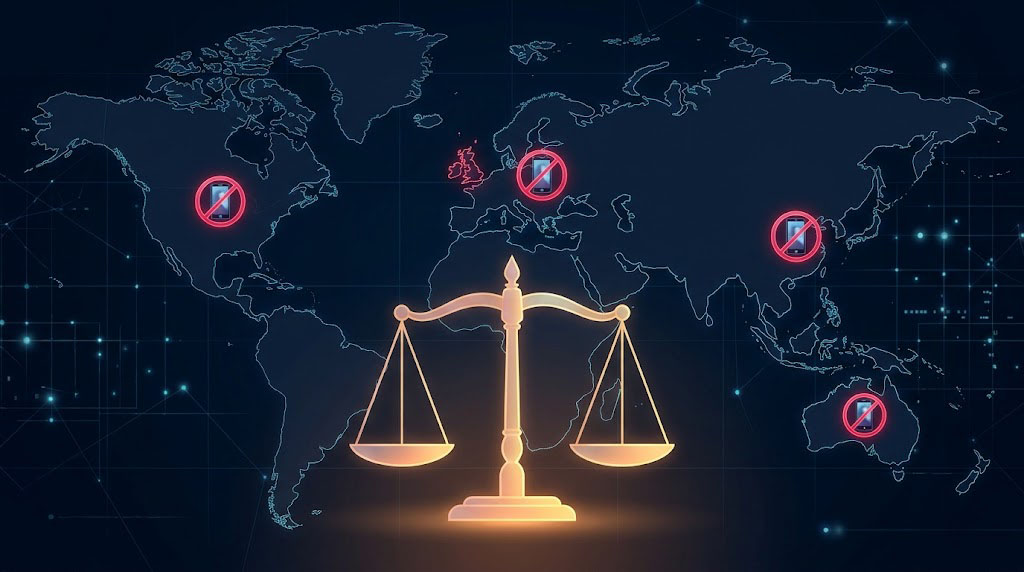
Image created using advanced AI technology, professionally refined by the Inside Intelligence Unit editorial team.
The EU ban on AI apps that undress real people applies on 2 December 2026, and it is no longer alone. The UK, Minnesota, Australia, South Korea, India, Canada and Italy are all moving against nudifier tools and sexual deepfakes, with very different methods. This is the country-by-country reference adult platforms need right now.
28 days
Until the EU ban applies
12
Jurisdictions tracked
€35M / 7%
Top EU fine
3 years
UK prison for supplying a nudify tool
01 · The update
What changed since the EU nudifier ban was approved?
Since the EU added nudifier apps to the AI Act's list of banned practices, at least six other jurisdictions have passed, enforced or tabled rules against the same tools. The question for adult platforms is no longer whether nudifier bans spread, but which version applies to which users.
Our original report on the EU AI Act nudifier ban covered the Parliament vote, the deadlines and the fines. This update keeps the EU at the centre and adds every other major legal system that has acted.
New since our October report
EU countdown: the ban now applies in 28 days, on 2 December 2026, together with the labelling deadline for existing generative AI tools.
Australia: the Online Safety Amendment (Digital Duty of Care) Bill 2026, which includes a ban on nudify apps, passed the House of Representatives on 28 October 2026.
Denmark: bill L 49, giving people a legal right over realistic digital copies of their face, voice and body, was tabled on 8 October 2026.
Minnesota: the first US state ban on nudification technology is on hold after the 8th Circuit granted xAI an injunction on 2 October 2026.
The trigger for most of these moves was the same event. In late December 2025 and January 2026, X's Grok chatbot was used to generate sexualised images of real women and minors at massive scale, and regulators on four continents opened investigations within weeks.
The Grok image wave that pushed lawmakers to act
Images posted by Grok in 9 days
4.4M
Sexualised images in under 2 weeks
3M+
Likely sexualised images of women
1.8M
Images appearing to depict children
23,000+
Source: Center for Countering Digital Hate (3M sexualised, 23,000 child-like); The New York Times (4.4M posted, 1.8M sexualised women), as compiled by BISI.
</> Embed this chart
<iframe src="https://inside.theporn.com/nudifier-ban-laws-worldwide-2026/#chart-grok-wave" width="100%" height="420" style="border:0;" loading="lazy" title="The Grok image wave that pushed lawmakers to act"></iframe>
<p>Source: <a href="https://inside.theporn.com/nudifier-ban-laws-worldwide-2026/">Nudifier Ban Laws 2026</a> – Inside The Porn</p>
Copy the code and paste it into your page. Please keep the source link.
Where does the EU nudifier ban stand in November 2026?
The EU nudifier ban is final law and applies from 2 December 2026. It sits in Article 5 of the AI Act, the list of prohibited AI practices, and was added by Regulation (EU) 2026/1744, the Digital Omnibus on AI.
The amending regulation was signed on 8 July 2026, published in the Official Journal on 24 July 2026 and entered into force on 27 July 2026. No further vote is needed before the ban starts.
What is banned
AI systems that generate images, video or audio showing the intimate parts of an identifiable person, or that person in sexually explicit activity, without consent. AI systems that generate child sexual abuse material are banned outright.
Who is liable
Providers break the ban when this output is the tool's purpose, or when it is reasonably foreseeable and reproducible without effective safeguards. Deployers who use such systems for that purpose are covered too.
Breaches of Article 5 carry the AI Act's highest fine tier: up to €35 million or 7% of worldwide annual turnover, whichever is higher. For SMEs and start-ups, the lower of the two figures applies.
The ban started as a Spanish proposal in January 2026, after the Grok images. France backed the amendment, and Parliament and Council agreed it in the trilogue deal of 7 May 2026.
Separate track: the X investigation
On 26 January 2026 the European Commission opened formal proceedings against X under the Digital Services Act. It is assessing whether X evaluated and mitigated the risks of Grok before deploying it in the EU, including the spread of manipulated sexually explicit images.
The same date, 2 December 2026, is the deadline for machine-readable labelling of AI output from generative tools already on the market before 2 August 2026. Our AI-generated adult content market data shows how many services this touches.
03 · Global tracker
Which countries ban nudify apps in 2026?
As of November 2026, the EU, the UK and Minnesota are the only places with laws written specifically against nudify tools, and Minnesota's is paused in court. Australia is close behind, while most other countries punish the creation or sharing of sexual deepfakes rather than the software itself.
Nudifier and sexual deepfake rules by jurisdiction (status at 4 November 2026)
Jurisdiction
Main rule
Targets
Max penalty
Status
European Union
AI Act Art. 5 ban on nudifier and CSAM-generating AI (Reg. 2026/1744)
Providers and deployers
€35M or 7% of turnover
Applies 2 Dec 2026
United Kingdom
Offence of making or supplying a generator of purported intimate images (s.66I SOA 2003)
Developers and suppliers
3 years' prison
In force 29 Jun 2026
United Kingdom
Creating or requesting a sexual deepfake of an adult without consent (s.66E–66F)
Users
6 months + unlimited fine
In force 6 Feb 2026
United States (federal)
TAKE IT DOWN Act: crime to publish NCII, 48-hour removal duty for platforms
Users and platforms
$53,088 per violation (FTC)
Enforced since 19 May 2026
United States (federal)
DEFIANCE Act: civil right to sue over sexual deepfakes
Creators and distributors
Civil damages
Passed Senate, House pending
Minnesota (US)
Ban on letting users create nudified images of identifiable people
Site operators and developers
$500,000 per use
Paused by 8th Circuit
Australia
Digital Duty of Care Bill 2026, including a nudify app ban
Tech companies
A$109.2M
Passed House, in Senate
South Korea
Crime to make, share, possess or watch sexual deepfakes
Users
7 years' prison
In force; new bill under review
India
IT Rules: mandatory AI labels and 3-hour takedowns
Platforms
Loss of safe harbour
In force 20 Feb 2026
Italy
Art. 612-quater Criminal Code: harmful sharing of AI deepfakes
Users
5 years' prison
In force 10 Oct 2025
France
Art. 226-8-1 Criminal Code: sharing sexual deepfakes without consent
Users
3 years + €75,000 (online)
In force
Canada
Bill C-16: intimate image offence extended to deepfakes and "nearly nude" images
Users
10 years (threat offence)
Mostly in force 18 Jul 2026
Denmark
Bill L 49: consent right over digital copies of face, voice and body
Publishers
Civil damages
Tabled; target 1 Jan 2027
Spain
Minors in digital environments law, adding a sexual deepfake offence
Users
Not yet set
In Congress
Maximum prison terms for nudifier and sexual deepfake offences
South Korea · making or sharing
7 yrs
Italy · harmful sharing
5 yrs
UK · supplying a nudify tool
3 yrs
France · sharing online
3 yrs
US · publishing adult NCII
2 yrs
UK · creating a deepfake
6 mo
Source: Inside Intelligence Unit analysis of legislation.gov.uk, Italian Law 132/2025, French Criminal Code, US TAKE IT DOWN Act and South Korean sexual crimes law. Maximum terms for the basic offence; aggravated cases can be higher.
</> Embed this chart
<iframe src="https://inside.theporn.com/nudifier-ban-laws-worldwide-2026/#chart-prison-terms" width="100%" height="460" style="border:0;" loading="lazy" title="Maximum prison terms for nudifier and sexual deepfake offences"></iframe>
<p>Source: <a href="https://inside.theporn.com/nudifier-ban-laws-worldwide-2026/">Nudifier Ban Laws 2026</a> – Inside The Porn</p>
Copy the code and paste it into your page. Please keep the source link.
Is it illegal to make or supply a nudify app in the UK?
Yes. Since 29 June 2026, making, adapting, supplying or offering to supply a tool for generating "purported intimate images" is a crime in England and Wales, punishable by up to 3 years in prison.
The offence is new section 66I of the Sexual Offences Act 2003, inserted by the Crime and Policing Act 2026, which received Royal Assent on 29 April 2026. A "thing" includes a program, electronic information or a service, so web apps and APIs are in scope.
The test is objective: the offence applies when a reasonable person would consider the tool is made or supplied for that use. The main defence is proving that all reasonable steps were taken to stop the tool being used on people without their consent.
3 yrs
Supplying a nudify tool
s.66I, in force 29 June 2026.
6 mo
Creating or requesting a deepfake
s.66E–66F, in force 6 February 2026.
48 h
Platform takedown window
For reported non-consensual intimate images.
Users are covered separately. Under sections 66E and 66F, added by the Data (Use and Access) Act 2025, creating or requesting a sexual deepfake of an adult without consent is an offence even if the image is never shared.
The Crime and Policing Act also requires platforms to remove reported non-consensual intimate images within 48 hours. Executives can face prison or fines for ignoring an Ofcom order without a reasonable excuse.
Ofcom opened a formal Online Safety Act investigation into X over Grok on 12 January 2026. UK operators should read this alongside our study of what happened to UK search traffic after age verification went live.
05 · United States
Are nudify apps banned in the United States?
Not at federal level. US federal law punishes publishing non-consensual intimate images and forces platforms to remove them, while the only state ban on nudification technology, in Minnesota, is on hold after a court challenge by xAI.
What does the TAKE IT DOWN Act require?
The TAKE IT DOWN Act makes it a federal crime to knowingly publish non-consensual intimate images, including AI-generated ones. Since 19 May 2026, covered platforms must also offer a removal process and take reported images down within 48 hours.
The FTC enforces the platform duty. It sent reminder letters to 15 major platforms, then warned 12 nudify websites that had no removal process at all. Each violation can cost up to $53,088.
What happened to Minnesota's nudification ban?
Minnesota passed the first US state ban on nudification technology, effective 1 August 2026. It bars site operators and developers from letting users create realistic images showing intimate body parts of an identifiable person that are not in the original photo.
The penalty is up to $500,000 per use, and victims can sue for damages. xAI challenged the law on First Amendment grounds. A federal district judge refused to block it in September, but the 8th Circuit granted xAI an injunction on 2 October 2026 while the case continues.
Key insight
The US fight is about free speech, not about the harm. No court has said nudifying real people is protected. The Minnesota case tests whether a state can ban the software itself, and the answer will shape every copycat bill.
Which other US rules are coming?
The DEFIANCE Act, which gives victims a federal right to sue the people who create or distribute sexual deepfakes, passed the Senate unanimously on 13 January 2026 and is waiting for the House. In Pennsylvania, a bill to ban the distribution of nudify apps is at committee stage.
Australia is about to ban nudify apps through a platform duty of care, South Korea already jails people for even watching sexual deepfakes, and India runs the world's fastest takedown clock at three hours.
Australia: a nudify ban inside a duty of care
The Online Safety Amendment (Digital Duty of Care) Bill 2026 was introduced on 15 October and passed the House of Representatives on 28 October 2026. Prime Minister Albanese said it will ban nudify apps because of the harm they cause young people.
Companies that fail to comply face fines of up to A$109.2 million. A Senate committee reports on 20 November, the government needs Greens or crossbench votes, and a 12-month transition applies after Royal Assent.
South Korea: the strictest rules on users
Since a 2024 amendment, South Korea punishes possessing, buying, storing or watching sexual deepfakes with up to 3 years in prison, and making or distributing them with up to 7 years.
Deepfake sex crimes rose from 31 cases in 2020 to 550 in 2024. A bill under review since August 2026 would extend the crimes to AI sexual content of fictional people, which would reach far beyond nudifier apps.
India: labels and a 3-hour clock
India's amended IT Rules, in force since 20 February 2026, require visible labels and embedded metadata on synthetic content and cut the takedown deadline for unlawful content from 36 hours to three.
Platforms must also use automated safeguards against non-consensual intimate imagery. The penalty for ignoring the rules is the loss of safe-harbour protection from liability.
Malaysia and Indonesia went further during the Grok crisis and temporarily blocked the chatbot, lifting the blocks after X committed to new safeguards. Traffic patterns in the region are covered in our analysis of how Indians access adult content.
07 · National laws
How do Italy, France, Spain, Denmark and Canada compare?
These five countries regulate the content and the people who share it, not the software. Italy and France already have deepfake crimes in their criminal codes, Canada extended its intimate image offence in 2026, and Spain and Denmark have bills in parliament.
Italy
Article 612-quater of the Criminal Code, added by Law 132/2025 and in force since 10 October 2025, punishes sharing AI-altered images, video or voices that cause unjust harm with 1 to 5 years in prison.
The data protection authority blocked one nudify service in October 2025 and asked Parliament in May 2026 for power to block deepfake platforms from Italy.
France
Article 226-8-1 of the Criminal Code punishes sharing sexual deepfakes of a person without consent with 2 years and €60,000, rising to 3 years and €75,000 when posted online.
France also backed Spain's amendment that became the EU nudifier ban.
Spain
Spain proposed the EU ban, but its own law is not finished. The Organic Law on protecting minors in digital environments, still in Congress, would add a sexual deepfake offence to the Criminal Code.
Denmark
Bill L 49, tabled on 8 October 2026, would make it unlawful to publish realistic digital copies of a person's face, voice or body without consent, with the publisher having to prove consent. Proposed start: 1 January 2027.
Canada
Bill C-16, the Protecting Victims Act, received Royal Assent on 18 June 2026, and most of it took effect on 18 July. It extends the non-consensual intimate image offence to sexual deepfakes, including "nearly nude" images.
It also adds an offence of threatening to distribute intimate images, with up to 10 years in prison on indictment. Canada's Privacy Commissioner separately expanded its probe into X over Grok.
Brazil gave xAI 30 days to stop fake sexualised images or face legal action. For the link between these laws and creator safety, see our guide to privacy protection for adult content creators.
08 · Two models
Do the laws ban the tool or punish the user?
Both, and the split decides who carries the legal risk. Tool bans make the developer and the platform liable, while content offences put the risk on the person who creates or shares the image.
The three regulatory models for nudifier apps
Model
Who is liable
Where it applies
Tool ban
Developers, providers, site operators
EU (Art. 5 AI Act), UK (s.66I), Minnesota (paused), Australia (bill)
Content offence
Users who create, share, possess or watch
UK (s.66E–66F), South Korea, Italy, France, Canada, US (TAKE IT DOWN)
Takedown duty
Platforms hosting the images
US (48 h), UK (48 h), India (3 h), EU (Digital Services Act)
The EU and UK rules share one important feature: a general-purpose generator is not banned just because it can make explicit images. Liability turns on intended purpose and on whether effective safeguards stop non-consensual images of real people.
That makes safeguards the real compliance product. Consent checks, blocking uploads of real people's photos for explicit edits, and filtering output are what separate a lawful adult generator from a banned nudifier. Our analysis of AI content moderation and false positives explains the trade-offs.
Key insight
Every law targets real people who never agreed, not explicit AI content as such. Fully synthetic adult characters remain legal in the EU, the UK and the US. South Korea's pending bill on fictional people is the only major exception on the horizon.
09 · Impact
What do the new laws mean for adult AI platforms?
Adult AI platforms that serve users worldwide now need one compliance baseline strong enough for the strictest market: no undressing of real people, effective safeguards, labelled output and a fast takedown process.
Image-upload features are the highest risk. Any feature that takes a photo of a real person and returns an explicit version is the exact function the EU, UK and Minnesota laws describe, whatever the product calls it.
AI companions and generators built on fictional characters sit outside the bans, but they still face the EU labelling rules and takedown duties. Our guides to AI models behind adult generators and the AI companion tech stack show where safeguards fit in the pipeline.
Global compliance checklist for 2 December 2026
Remove or lock down any feature that edits uploaded photos of real people into nude or sexual images.
Block explicit generation that uses a real person's face as a reference without documented consent.
Add machine-readable marks (metadata or watermarks) to every AI image, video and audio file for EU users.
Publish a removal request process and act within 48 hours for the US and UK, and 3 hours for India.
Keep age and consent records for any real performer whose likeness is used.
Filter prompts and outputs for any sign of minors, a red line in every jurisdiction tracked.
Check that your GPU and payment providers accept your safeguards, since their terms often go further than the law.
The next three months decide the global map. The EU ban starts on 2 December 2026, Australia's Senate decides on its nudify ban, and the Minnesota appeal will show whether US states can outlaw the tools themselves.
Days left until upcoming nudifier law milestones (from 4 November 2026)
Australia Senate committee report
16 days
EU nudifier ban & labelling
28 days
Denmark likeness law (proposed)
58 days
EU stand-alone high-risk AI
393 days
Source: Inside Intelligence Unit calculation on dates from Regulation (EU) 2026/1744, the Australian Parliament and Danish bill L 49.
</> Embed this chart
<iframe src="https://inside.theporn.com/nudifier-ban-laws-worldwide-2026/#chart-countdown" width="100%" height="400" style="border:0;" loading="lazy" title="Days left until upcoming nudifier law milestones"></iframe>
<p>Source: <a href="https://inside.theporn.com/nudifier-ban-laws-worldwide-2026/">Nudifier Ban Laws 2026</a> – Inside The Porn</p>
Copy the code and paste it into your page. Please keep the source link.
20 November 2026
Australian Senate committee report
The report on the Digital Duty of Care Bill opens the final Senate debate on the nudify ban.
2 December 2026
EU nudifier and CSAM ban applies
Also the deadline for machine-readable labels on generative AI tools already on the EU market.
1 January 2027
Denmark's likeness right (proposed)
Planned start of consent rules for digital copies of face, voice and body, if bill L 49 passes.
Pending
Minnesota appeal, DEFIANCE Act, Korean and Spanish bills
No fixed dates yet. Each would change the risk map for AI generators serving those markets.
2 December 2027
EU stand-alone high-risk AI obligations
The delayed AI Act rules for Annex III systems, such as biometrics and hiring tools.
Key takeaways
The EU ban applies on 2 December 2026 and covers AI that sexualises identifiable people without consent, with fines up to €35M or 7% of turnover.
The UK already criminalises supplying nudify tools, with up to 3 years in prison since 29 June 2026.
The US has no federal tool ban, but the TAKE IT DOWN Act forces 48-hour removals and the FTC has warned 12 nudify sites.
Minnesota's $500,000-per-use ban is paused by the 8th Circuit, making it the key First Amendment test case.
Australia is weeks from a nudify ban backed by fines up to A$109.2 million, if the Senate passes it.
Fictional adult AI stays legal almost everywhere; real faces without consent are the global red line.
External Reference Access | Adult Industry Mapping
You are leaving the Inside Intelligence Unit (IIU) to access an adult industry resource. This reference is utilized for industry mapping and methodological cross-referencing within the adult digital sector.
By proceeding, I confirm that:
I am of legal age (18+) in my jurisdiction.
I am accessing this resource strictly for professional research, analytical, or peer-verification purposes.
I acknowledge the adult-oriented nature of the external industry data being consulted.